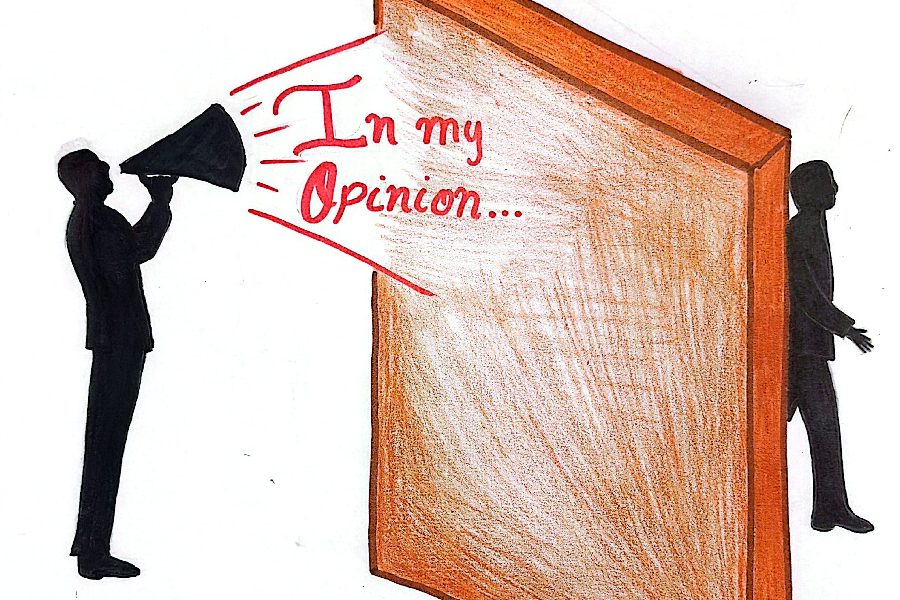
“Keep it to yourself.”
Who actually decides what can and cannot be said? The constant worry of offending someone, accidentally addressing something controversial, or becoming a social outcast has become a prevalent issue in society. There seems to be a requirement for a balance between what can be said and what should be kept personal, but currently the scale is toppled over, causing everyone to keep their thoughts to themselves out of fear of being judged.
From a young age, students are encouraged to create their own opinions in classes by being taught the ability to argue a point with accurate details to make it convincing. Then, their performance is graded, usually on the credibility and accuracy of the provided supporting information.
However, when this skill is applied to a daily lifestyle, many don’t get past simply stating what they believe. If someone was to say an irregular opinion, situations often become awkward and don’t provide an environment meant to nurture ideas. They can’t defend themselves, as they get cut off by those unwilling to accept the difference in perspectives.
Even on college campuses, like that of Harvard, only a third of the 2024 graduating class felt comfortable expressing a thought regarding a controversial topic.
There is an untraceable pressure to have one’s opinion match that of surrounding peers. The Ghostwriter publishes soundbyte videos, where the journalist asks the same question to multiple people throughout Westford Academy. When first asked, most students responded with the question, “What were the other responses?”. The fear of saying what is considered “socially wrong” or just simply not the same as what others believe constantly plagues the mind.
Neuroscience of Self and Self-Regulation explains how the human brain naturally alters or stops thoughts, feelings, and actions to fit societal standards or to reach certain goals.
This incline towards social acceptance causes individuals to immediately disregard others opinions instead of having proper conversations regarding their thoughts. However, there is no point in denying someone else their ability to express their opinions. By doing so, you are not changing their perspective, nor defending yourself. By listening to what they have to say, one could gain insight on opposing arguments or even be convinced enough to change their own perspective, and vice versa.
The desire to fit in has become stronger than creating the one true thing a person can control, their own opinion. There is a difference between having commonalities with friends, and simply copying a friends’ argument.
Blindly basing your opinion off of what others believe leads to opinions formed without any prior information. A lack of information means having an inadequate amount of detail to form a strong argument.
There is also this impression that everyone should have a stand on popular topics because they want to be included. Even though certain people may not have a particular interest in the subject matter, they simply feel the need to address it, whether it’s to praise or denounce it.
Although the desire to fit in and wanting to be knowledgeable of popular topics are valid reasons for people to be concerned about having an uncommon opinion, ignoring the existence of these viewpoints is not going to lead to them being erased. The correct way to go about it is to address them and show the reason why it is not a strong argument. An alternative way of understanding someone’s viewpoint is by figuring out the reason these beliefs came to be, which can be from a lack of information or misinformation, prejudice, or simply following someone else’s opinion.
Unity isn’t always better. Sometimes it’s better to have an opinion that can contradict someone else. This can lead to very highly valuable conversations and debates.
The severe reprimands that come in response for saying an uncommon perspective has become unreasonable. Everyone should understand that their opinion is not the only “correct” one and be willing to listen and have discussions with others who have opposing opinions. Take the initiative and go listen to someone you had a disagreement with and truly hear their voice before judging them.