

The vast field of healthcare is not for everyone. Often requiring more than the typical four years of post-secondary education, these careers involve long hours, high-stress environments, and a passion for helping others. However, these demanding conditions have not deterred this year’s graduating class one bit; the Class of 2026 seems to be full of students prepared to handle them and much more.
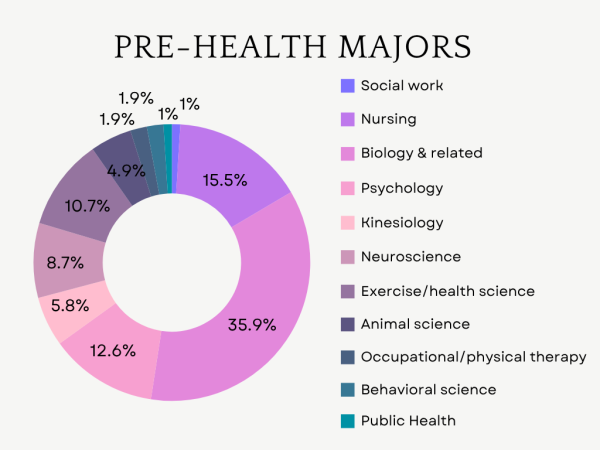
With a 53% increase from the average proportion of a Westford Academy senior class planning to pursue a pre-health major, nearly one-third of the class of 2026–according to The WA Ghostwriter’s WA Graduates Google form responses as of May 10–has decided to place themselves on track to become one of the millions of professionals around the globe working to save lives.
“This class cares about things outside themselves. I know you’re teenagers, and […] you should be hyper-focused on yourself, especially in these next three months or four months. But certainly, all of the experiences that I’ve had, I’ve just seen so many of these 26’ers doing good things for other people without necessarily needing the reward outside of the doing,” Class of 2026 adviser Michael Towers said. “That’s what it’s all about, not doing for sake of resume, or doing for sake of recognition, doing for sake of doing and learning and growing as a person.”
Within the pre-health majors this year, a fifth (approximately 21.3%) are planning to major in Nursing. This specific path sees a roughly 300% increase from previous years and is the largest chosen health-related major so far for the Class of 2026.
“I have definitely noticed an increase in seniors wanting to major in Nursing. For the Class of 2025 at WA for example, I only remember hearing of a handful of people planning to major in Nursing, like five people max,” senior Natalie Bearfield, who plans to major in Nursing at the University of Connecticut this fall, said. “This year, it seems like the numbers are a lot more saturated.”
According to Bearfield, this drastic growth may stem from a fear of artificial intelligence (AI) replacing other careers.
“I think that this increase mainly comes from the job security that nursing and health-related professions have. Unfortunately, a lot of people are being replaced in their jobs by AI and other technology, so the job market is definitely dwindling quite a bit,” Bearfield said. “Thankfully, nurses and other healthcare [professionals] can’t really be replaced by AI completely the way that some other fields can.”
Critics claim that the personal connection fostered by doctors, nurses, veterinarians, and dozens of other professionals in the healthcare field is not one that is replicable or replaceable by AI.
“I find that the Class of ’26 is loaded with other people who have and are willing to serve others,” Towers said. “So these professions that we’re talking about, that’s exactly what that is. You have to have that ability to focus outside yourself, no matter what’s going on inside. […] And that’s hard, I can tell you as a teacher, it’s incredibly hard. But that’s the job.”
Senior Srisai Vuppuluri originally planned to pursue a career in aerospace engineering. However, emphasizing Towers’ point, Vuppuluri, who now plans to major in Biological Sciences on the Pre-Med Track at Drexel University, states that his interest in the area stemmed from a desire to create a positive difference in people’s lives.
“I wanted to go into medicine because of my passion for helping others,” Vuppuluri said. “During my time [volunteering] at [Mass General Brigham hospital], I felt like I was genuinely making an impact on people’s lives, no matter how small, which made me want to do it moving forward.”
Senior Sharon Lin, Animal Science at University of Massachusetts (UMass) Amherst on the Pre-Vet Track, shares a similar sentiment.
“My younger self would have wanted to become a veterinarian to play and help cute puppies, but now I can appreciate the compassion and dedication that a career in veterinary medicine holds,” Lin said.
Beyond the lack of possibility of replacement from advancing technology, some students believe that the mere vastness of the field encourages those not completely sure about their future aspirations to take part.
“I’ve definitely noticed an increase in seniors pursuing pre-health, and I think it’s stemming from a mix of genuine opportunity and some career uncertainty,” senior Alveena Hammad, a soon-to-be Biology major on the Pre-Dental Track at UMass Amherst, said. “Since the pre-health track is so broad and rigorous, it allows [pursuers] to keep their options open and stay in a high-opportunity lane while they take the time to figure out their specific professional calling.”
Regardless of the reasons this year’s seniors have taken to the medical field, Towers believes they are well-suited for the job, stating that he wouldn’t mind seeing one of them as a patient in the future.
“You know, there’s a calm and a reassurance to it, because now I know that this person certainly has my very best interest, even though the career, the profession, requires that you do,” Towers said. “I would like to think that I would say, ‘I trust my life in your hands.'”