

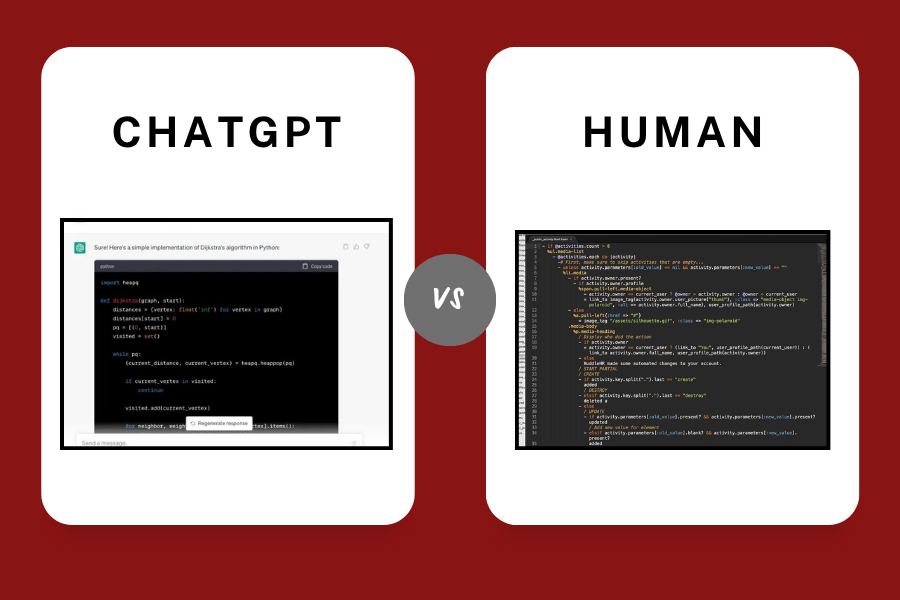
As May 1st came and went, the age old wave of worry about application deadlines came upon Westford Academy students, and decisions about majors followed suit. As seniors begin to think about colleges and majors, the choice is typically made based on one’s passions and strengths. But according to an article by Black Enterprise, a new concern for majors has become more prevalent throughout the past few years, deciding which majors could be taken control of by Artifical Intelligence (AI).
A national poll conducted by The Hill determined that 47% of students already enrolled in college have frequently thought about switching their majors due to concerns over the rapid growth of AI. A separate poll conducted by Axios News revealed that 16% of all currently enrolled college students have already switched their majors, and 25% of those students were majoring in technology-related subjects.
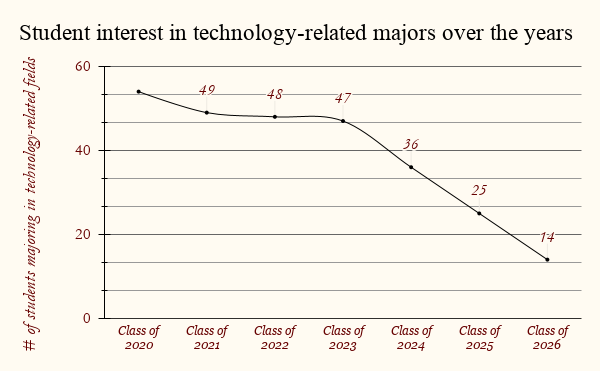
According to research conducted by the WA Ghostwriter through the WA Graduates Instagram account, interest in technology-related majors dropped around 13% overall from 2020 to 2026, with the class of 2020 reported to have 53 students, or around 17%, who chose to enroll in computer science or statistical-related majors. That number dropped to 47 out of 280 with the class of 2023. The total dwindled even more by the class of 2026, with roughly 12%, or only 14 students, who chose to enter computer science or statistical-related majors as of April 29.
In the article by Black Enterprise, it’s revealed that students are leaning more towards majors that are perceived to be “AI-Proof”. This encompasses majors such as nursing, therapy, and other subjects that center high-level emotional intelligence and manual dexterity and are less likely to be engulfed by AI as it continues to develop.
However, workers already in the computer science field have different opinions.
Anamitra Bhattacharyya is a Maximo Architect — a highly specialized IT consultant responsible for designing, building, and deploying enterprise asset management solutions — at International Business Machines (IBM), and has over 29 years of experience under his belt. With this, he holds the belief that AI will bring great advancements to the field of computer science.
“My belief is that [future computer scientists] will learn to leverage AI and enhance their productivity, so there will be more [people experienced with AI] as opposed to us, who were not born with AI,” Bhattacharyya said.
Bhattacharyya holds the belief that this new and additional learning curve will do more good than harm to computer science-related jobs and opportunities in the future.
“While there will be an initial dip in the number of jobs, I don’t think it will be a permanent dip,” Bhattacharyya said. “It is going to pick up because there is always [going to be] more need to digitize the world.”
Along with this, some teachers at WA report that there hasn’t been a dramatic change in the volume of students majoring in AI-vulnerable subjects such as computer science.
“I still hear the kids saying that they want to major in computer science or go into healthcare,” math and computer science teacher Cheri Fisher said.
Fisher’s observation is at odds with a statistic from a poll held by Business Insider, where interest in computer science at the college level dropped from 14% in 2020 to 10% in 2026. Though in turn, interest in AI-related majors rose from 1.7% in 2023 to 4.7% in 2026.
While students who actively take computer science classes are willing to major in subjects related to it, other staff who have worked with upperclassmen interested in a wide range of different majors have noted that there has been a noticeable shift in student decisions when it comes to their major.
“Working with seniors, computer science is [still] an interest for sure, but I definitely see a tailing off of it because they’re worried about AI and how that could impact programming,” guidance counselor Brian Doherty said.
While studies, such as ones conducted by The Hill and Business Insider, have tracked the recent effects that AI has had on majors, there is a discrepancy of data at the high school level. Although there are results seen at WA showing the significant decrease of interest in technology-related majors, this is not the case for all schools in Massachusetts or nationally.
While it may not be a huge concern in the present, the future development of AI could lead to changes in the way students decide their future majors. Since developments are already being seen at the college level, it’s a predicted possibility that high schools will soon be affected as well, as stated in an article by WIRED. WA itself is already showing signs of aversion to studying subjects that have a higher chance of being vulnerable to AI.
“I think that it will trickle down to us eventually, and the kids here will be [given more] awareness from older siblings or [other] people they know going through the college process,” Fisher said, “They’ll be more aware of which majors won’t be as popular because of AI taking over. I think it will [take over], I just think it hasn’t yet.”
Despite this, Bhattacharyya believes there’s nothing to worry about. As supported through an article written by the National Institute of Health (NIH), fears and apprehension towards technological developments such as AI have always and will always continue to exist. The NIH states that this fear is a natural response to what humans don’t fully understand, and it will take a while before the majority of society can acclimate to something so new.
“More jobs will be created. This is what has happened in the past for any technological revolution,” Bhattacharyya said. “We fully expect more jobs to be created. I think the future is still very bright for computer science graduates.”
