

by Tanvi Verma
Staff Writer
Not getting enough sleep at night can not only affect your concentration, but your mood too. Moodiness and irritation might just be because you’re not getting enough rest.
According to research, teenagers should be getting about ten to eleven hours of sleep every night in order to function best. However, after speaking with a variety of different students from varying classes, it is clear that most get from 7-8 hours per night.
“I mean, if I don’t get enough sleep, then I fall asleep in class”, said senior Randi Medley.
For many teens, waking up can be the most difficult part of the day. Freshman Nate Merrel tries to wake himself up in the morning by drinking coffee; he claims that his lack of sleep (six hours per night) does not affect his schoolwork at all. Caffeine, however, is linked to several sleep disorders such as insomnia because of its psychological repercussions according to the January 2008 and December 2004 issues of Time Magazine. In excess, caffeine can be quite addicting. If you want to feel awake in the morning, get to bed early and do a little yoga when you wake up according to the June 2009 issue of Newsweek.
“I don’t notice a difference really with caffeine. I think it’s bad for you too. There is no complete substitute for sleep,” said freshman Renée Craig who gets 7 hours of sleep every night.
According to research conducted on 257 boys over ten years by Time Magazine in 2004, teenagers who get less sleep over time are more likely to resort to drug use and drinking later on in life because of the depressive effects of a lack of sleep.
Lack of sleep can be best explained in a kind of vicious cycle. If one doesn’t get enough sleep at night because they procrastinated on doing homework, their concentration the following day will not be at its best. Not being able to concentrate will lead to more procrastination which will lead to less sleep which, again, will lead to a lack of concentration the next day and so on. In order to escape this cycle, just do what your teachers say and don’t procrastinate.
Having an irregular sleep pattern also influences your quality of sleep according to Understanding Psychology 2001. Because teenagers go to sleep so late on the weekdays to finish schoolwork and creep on Facebook, many try to compensate for lost rest by oversleeping on the weekends. This, however, warps your biological clock and actually leads to even wor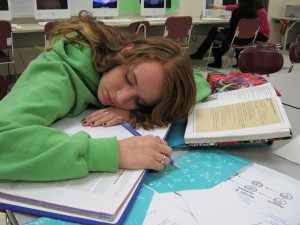 se sleep later on. The best thing to do is just have a fixed bedtime every night, and maybe sleep in an hour or two on the weekends.
In the February 2011 edition of Newsweek Magazine, research conducted shows that less sleep shows a decrease in memory function. If you know that you have a big test tomorrow, sleep can be vital in performing your best.
“If I notice that students are tired, there generally is a correlation to less focus and decreased performance,” said English teacher Janet Keirstead.
The December 17, 2004 issue of TIME Magazine explores the issue of our biological clocks further in an article written by Christine Gorman called ‘Why We Sleep’. After many hours without sleep, the reaction time of a person begins to slow. People ‘zone out’ and start staring into space and can’t concentrate on their work because of their exhaustion. The quality of one’s work can become severely hindered.
“I think it builds up. If you get no sleep for four nights in a row, then it effects you”, said freshman Andrew Clark, who averages about seven hours of sleep per night and claims that amount doesn’t hinder his academic abilities.
The bottom line is this: nothing can replace sleep. Not caffeine, not trying to nap in class. There is simply nothing that can substitute for rest. If you want to perform best for a game, a big test, or a Saturday night dance, then be sure to get at least eight and a half hours of sleep in order to have the energy that you’ll need.