

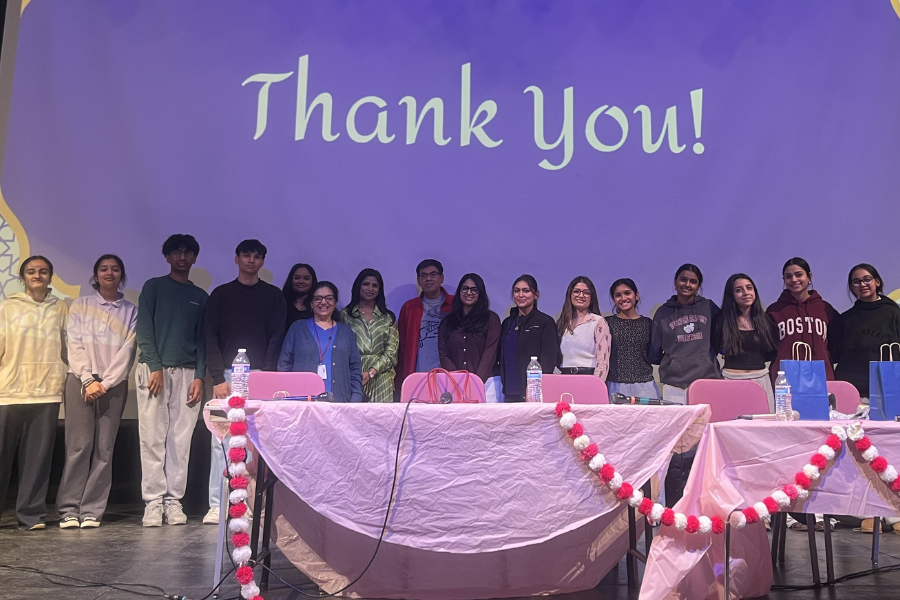
The hum of conversation fills the room as rows of students take their seats with questions at the ready. For many, this wasn’t just another school event, but an opportunity to share stories, navigate identity, and channel ambition into a competitive environment that doesn’t always make room for all three. It is the first time Westford Academy has seen anything like it, and the South Asian Student Association (SASA) has made it happen.
On Wednesday, March 25, SASA hosted a one-of-a-kind panel in which students posed questions to South Asian professionals in various fields including healthcare, finance, real estate, and engineering. This was made in an attempt to create a space where students of a similar background could learn and take advice from their professional experiences.
“Although we have had guest speakers before [during club meetings], this is the first South Asian career panel that has been hosted in the school. We’re really grateful to our guests and panelists for being willing to come,” SASA adviser and English teacher Rashmi Kumar said.
The idea for the career panel was sprung after some students requested a more personal view into what life would be like after WA. To satisfy this desire, SASA cabinet members decided that the panel was going to be presented through a Q&A format in which a student could ask a general question that would be answered by each of the panelists, or a more specific inquiry based on an individual speaker’s profession.
“[This career panel] gave South Asian students the opportunity to get an inside look into what life will be like once they’re settled into their career,” junior co-social media manager Anushka Tekade said. “Everyone has their own experiences, but I feel like hearing it from someone you can relate to gives [you] a deeper understanding.”
In order to set this panel into motion, SASA cabinet members worked as a collective for several weeks to find a network of friends and relatives that would be willing to answer questions of ranging topics about their career of choice. Additionally, they created advertisements on their social media and for the morning announcements to encourage students to attend the event.
“When I first heard of the career panel, I knew that I wanted to go because I had never seen anything like it before,” sophomore attendee Snithik Kollipara said. “I’m really glad I came because all of the panelists were all different ages and came from different backgrounds, so it was very helpful to see what people are doing in the career I want to be in.”
The five panelists included software engineer Anamitra Bhattacharyya, dental assistant Samra Khalid, real estate agent and SASA sponsor Padma Sonti, senior accountant Dipanshi Shah, and patient administrative representative Seema Shah.
Upon introducing themselves to the attendees, each panelist disclosed where they went to college, what they studied, and their current workplace. According to co-president Shaivi Shah, this disclosure of information was vital for students to see different educational backgrounds and how it manifested into a career choice.
“This panel wasn’t just to delve deep into South Asian experiences, but also to find out what field you may be interested in and get your questions across,” Shah said. “It was also really important to see how different panelists overcame challenges and how [one] may have to face that one day.”
To start the event off, attendees focused on questions regarding how their heritage and how it affected their career choice and if any aspect of their culture motivated them to go into a certain career path.
“Growing up, there were two choices: either become a doctor or an engineer. For me, it was very clear that [the medical field] was not my thing, so it was an easy choice to go into engineering,” Bhattacharyya said. “I wasn’t very certain on what career path to choose, but one of my relatives said that because I loved geometry, I would be a good software engineer.”
As the panel progressed, the speakers delved deeper and shared their personal experiences within their respective workplaces, including instances of racial bias from higher-ups and handling misconceptions others may have about their career or of their ethnic background.
“Most people think that [real estate] is an easy job, while [it’s actually] the opposite. It’s one of the toughest jobs to do,” Sonti said. “My career is mostly emotional connections to other human beings whose money is involved and it’s not a simple thing. No two days are alike; everyday is someone discounting me for being Asian and being a female.”
Throughout the year, SASA holds many events for students to celebrate South Asian culture, including their annual Darba dance and collaborations with other clubs, including the Muslim Student Association. Looking into the future, SASA hopes to continue hosting this career panel and making it an annual event for their club members.
“This was a first and that’s all that takes for a tradition to be started. Hopefully next year, we can have a second annual SASA career panel and many more after that,” Shaivi said.
