

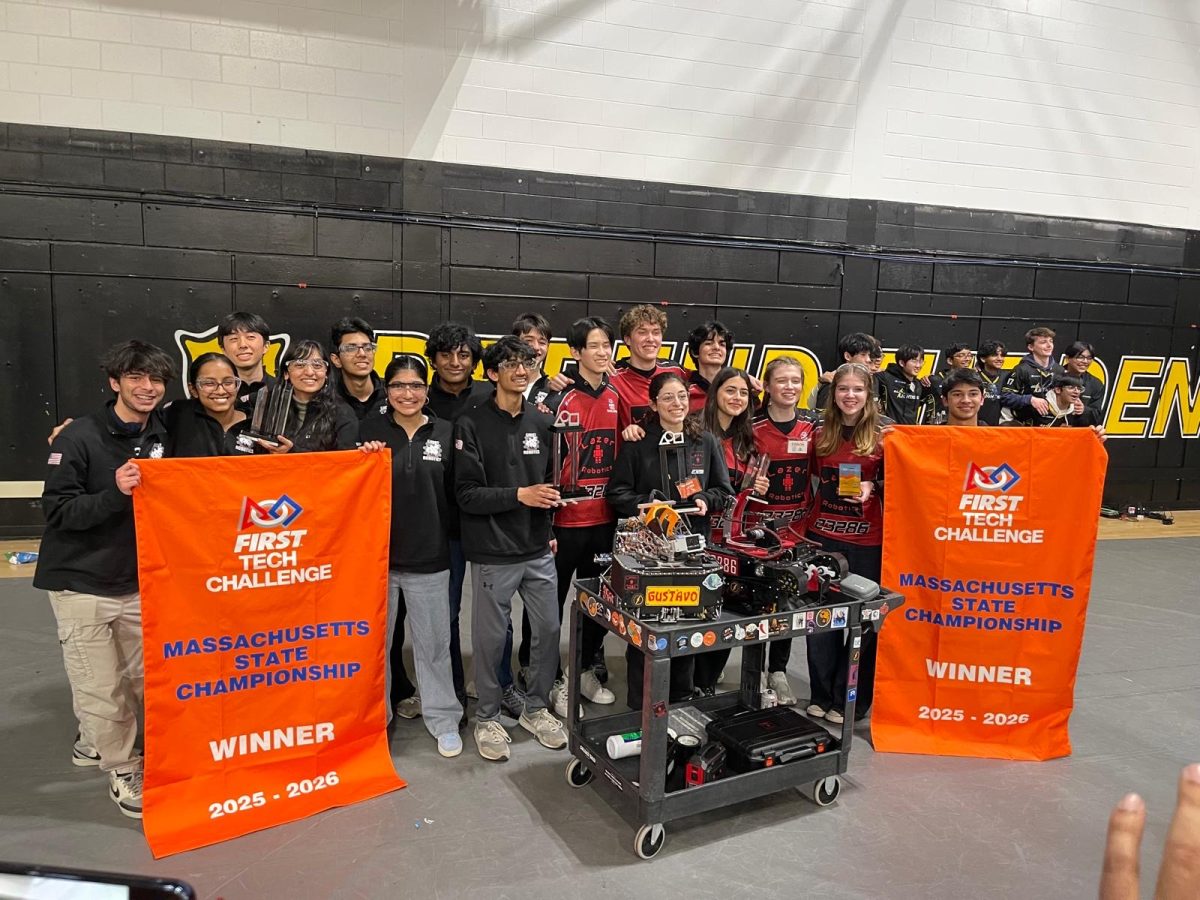
At the Massachusetts State Championship For Inspiration and Recognition of Science and Technology (FIRST) competition, the WA Robotics Team won the Massachusetts Division title. This earned them a spot at the World Championship, a historic accomplishment for the team.
This earned them a spot at the World Championship competition, set to be held in Houston, Texas on April 28. The team is currently ranked 10th globally out of 7,800 teams. Prior to this competition, the ten-member team attended two qualifiers that allowed them to go through to the state competition after their season began on Sep. 7, 2025 when FIRST announced the challenge that they would complete, which included building a robot that throws wiffle balls into a hopper.
Their first contest was mid-January, which was their first qualifying competition in which they won. After that, they had one more qualifying meet in February. Despite already being qualified for states, the team participated in the event regardless.
“The big thing about that [was] that [the competition] really showed us a shot at worlds level,” junior club member Ethan Gilmore-Wahlberg said. “There’s this thing called OPR, a record of how well a team does at their competition, and a website where you can compare that to teams around the nation, state, [and] the world. At the end of that [competition] we were 11th overall in the world for OPR.”
Although the objective and general concepts of the robot will remain the same throughout the entire season, the team is constantly working to improve their design.
“Each competition, everyone’s robot gets better. You can’t just stay with the same robot, because other teams are improving theirs as well,” robotics club advisor Callie Borden said.
According to junior club member Sim Ali, there are many aspects that go into a typical competition day and many elements of criteria that the team and their robot must meet to be successful. The day begins with an inspection by judges to ensure that the robot is legal. Then, not only is the robot’s performance in the game judged, the whole team’s accomplishments are presented for consideration as well.
“FIRST really puts an emphasis on not just having technical skills and building a robot, but they like teams who do stuff for their community and help spread the message of FIRST, which is gracious professionalism,” Ali said.
The team’s contributions to the community were an aspect that allowed them to stand out in competition, including holiday events like Trunk-or-Treat and the Holiday Bazaar, and in particular their completely student–run summer camp.
“Every summer for three weeks we run two sets of summer camps,” junior club secretary Omkar Naluvala said. “One of them is focused on electronics […] and we help [kids] to make these little robots that are [trained in] line following and obstacle avoidance. The second and third weeks of camp are more focused on our style of competition. These are a lot more for training people who are going to come to the high schools and participate in FTC, the FIRST tech competition.”
After the season for the year is released in September, work begins almost immediately with the teams beginning to brainstorm ideas for the robot.
“What we do every year, it’s been a tradition, [is] we go to this competition called robot in three weeks, [and] it’s like a scrimmage three weeks after the season [is] released,” junior head engineer Ayush Warke said. “It’s a quick robot. Then from there we can identify what we want to change about the robot, and we have scrimmages dispersed through November and December.”
Once they get the general idea of what they want to build, it’s designed in a program called OnShape, which creates 3D computer design blueprints. From that, model 3D parts are designed and manufactured so construction can begin. The team has rebuilt their robot at least four times this season.
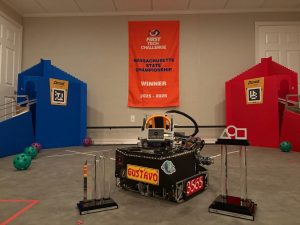
“We learn from the previous robot, and then just start with a blank canvas,” Ali said.
This new approach to integrating improvements is new to Ghosts Robotics.
“That’s what they’ve recently decided to do,” Borden said. “After States, they’re now taking it apart and they’re rebuilding an entirely new robot.”
Matches are structured with 30 seconds of autonomous robot performance, and two minutes are human operated. The team now holds the state record for the highest total points scored for this season, despite a miscount by the judges, missing eight balls from their total score.
According to senior captain Pranav Khurana, what makes this season and their success different from the past is the bond and commitment between the members of the team.
“Last season we had very few members that were contributing and our seniors were graduating, but over the [past] year other people have been able to build their stills, and we have a very well functioning team,” Khurana said. “We’re able to distribute a lot of the work, and we have a lot of hands on the robot instead of all the work falling on a couple people, and that’s definitely one of the biggest reasons that we’ve been able to come so far.”
However, the team doesn’t only meet in school. They have formed a tight knit bond with each other outside of school as well, proving that they are more than simply a competitive team.
“At the start of the season I specifically took a little bit of initiative, like we need to meet outside of school [and not] just do robotics and just hangout, […] so now we do a lot of things together and I feel like that was the start of it,” Khurana said. “We went on team dinners which were really fun. Now we’re a team, we’re together.”
