

When a young child pictures high school they see tests, homework assignments, and textbooks. Some may even picture the social aspect of it all too — meeting up with friends after school or the freedom that comes with having a driver’s license. However, what is not often pictured is the important opportunities that stem beyond the classroom which are pivotal to a students future.
The high school experience is often one that is described as preparation for “what comes next”. But despite this, students are rarely actually exposed to opportunities that go beyond school and bolster their chances for the future. Scholarships, academic competitions, and internships frequently appear abundantly throughout teachers or department heads emails, but how often are these possibilities extended to students?
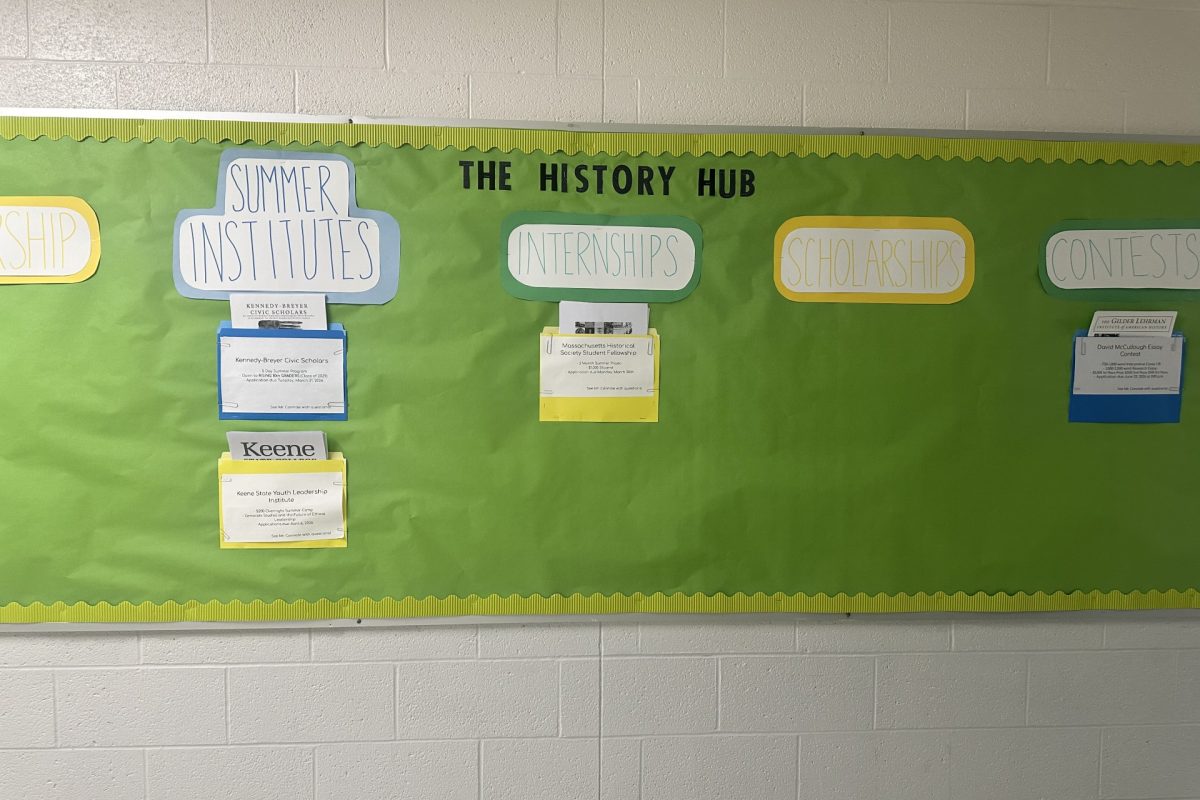
Recently, history department head Christopher Connole has made an effort to combat this ongoing issue by setting up “The History Hub” on a bulletin board in WA’s history hallway. This bulletin board features a multitude of history focused scholarships, summer opportunities, internships, and academic competitions. It is incredibly important that all of WA’s departments look into setting up something like “The History Hub” to benefit students in other areas of academic interest.
“I was getting a large number of emails from academic institutions that were offering all kinds of [opportunities] for students,” Connole said. “At some point during filing all of these emails into a folder, I realized there’s no way students actually know these exist and that they weren’t being promoted anywhere.”
While at first glance this bulletin board may just seem like a small addition to the halls of WA, it actually goes to represent something much larger for students: motivation.
One of the largest issues high schoolers face is burnout or a lack of motivation. According to the Search Institute, a recent survey has revealed that 69% of teachers have reported low motivation being an academic hindrance in the classroom.
With the mounds of schoolwork many students already have to put their little amount of motivation into, it is understandable for them to not want to spend their remaining time on a hunt for extracurriculars that apply to their interests. By placing such opportunities in a place where students walk by everyday, it can reignite their motivation while making the process of finding an internship or summer program efficient. In addition, the application process for many of those opportunities that Connole currently has displayed are relatively easy. While one involves a brief 500 word essay, others are simply just submitting a previous piece of work, such as a research paper or assignment. These quick and easy application processes only serve to further lessen the load on students.
Not only will some of these programs assist students in future situations like applying to colleges, they can also provide support to students struggling financially through scholarships and awards. According to the Hildreth Institute, eight in ten students pursuing higher education at a public college in the state of Massachusetts have $12,000 worth of unmet financial aid. To try and help this, many of the opportunities displayed on the board can deliver some sort of cash prize to students who participate.
As colleges only get more expensive as the years go on, many of these cash offerings can make a true difference in the life of a student who is seeking to pursue a higher education, but may not have the means to afford it at the moment. Additionally, it can even help beyond college, as it will decrease the debt they leave college with.
This bulletin board does not only reinvigorate motivation for students, but also lets them see their education with a wider world view. Completing assignments and studying for tests can begin to feel mechanical after multiple years of high school, but seeing “The History Hub” and the opportunities it offers can encourage students to think about their futures in a more proactive manner. Even the simple process of completing an application can build confidence for a student and model real life experiences, such as applying for a job.
“It’s just getting kids more aware of the opportunities they have in front of them, because I don’t think that has always been part of the culture here,” Connole said. “There’s this idea of taking history and social studies classes but then there’s nothing you do outside of those courses.”
Earning the internship or summer program presented in these applications offers a whole different scope of opportunities beyond just building confidence. According to Harvard University, academic extracurriculars can help your college application stand out from the hundreds of others that have similarly high test scores and grades by showing a commitment to achieving a goal or a willingness to take on new challenges.
With all the benefits that come with “The History Hub”, it begs the question of why other departments are not doing this as well, but instead letting the numerous opportunities build up in their inbox? According to Connole, a majority of students at WA show interest in pursuing something in the science and math field. Having a board for new opportunities in all departments can extend every student the same chance for a bonus on their college applications.
Instead of students walking through the hallways in a stressful fog of what assignments are yet to be completed or tests to prepare for, they can walk through the hallways and see eye-opening inspiration. The English hallway could feature writing or poetry competitions, while the science hallway could showcase research and lab opportunities.
As “The History Hub” is very new, the full effect of it has yet to be seen. This may have some claiming that it doesn’t make enough of a difference to put effort into a board for every department, however if just a few people acknowledge and take advantage of the board, it can slowly develop into something much larger for everyone to see.
“I got a late start, I didn’t start the board until January and a lot of these opportunities came in September, October, and November,” Connole said. “But if I can get even one or two people to look at it and take [a flyer], it can build up over time.”
According to Connole, the board does not take much effort, as many of the opportunities have fallen into his lap. For each department, taking time into putting this together would not be difficult with a little collaboration.
‘The History Hub” is not just something to look at, rather, it is something that represents students thinking about the future. High school does not need to only be centered around academics, but instead should be about discovering your interests and what applies to each individual person. By every department providing students an opportunity to do this, it can close the gap between thinking about the future, and putting action into it.
