Westford Academy has a diverse student body, and many of its students fit into more than one student group. For those who are both Muslim and South Asian, a special club collaboration worked to represent their unique lifestyle during the month of Ramadan.
Two of WA’s cultural clubs, South Asian Student Association (SASA) and Muslim Student Association (MSA), collaborated for a special club meeting on Wednesday, March 11 in the Lecture Hall. The collaboration consisted of an MSA-led presentation on Ramadan and fun activities handled by both clubs.
SASA was established in 2022 with the assistance of the efforts of adviser and English teacher Rashmi Kumar. The club introduced South Asian celebrations, cultural club meetings, fundraisers, and an outlet for South Asian American students to proudly showcase their culture. It also initiated the improvement of inclusivity within the school and strives to help everyone better understand the many cultures originating from South Asia.
MSA was founded this 2025-2026 school year by senior Simrah Azmi and junior Arleyya Mohd. The club focuses on current event discussions, creating events for Ramadan and Eid al-Fitr, and on challenging stereotypes surrounding Muslims. Their club has also served as a place for people to connect and learn more about Islamic culture, while being a place to hang out for those willing to learn more.
The collaboration meeting began with a presentation relaying information about Muslim practices that typically occur during the month of Ramadan. The month occurs on a calendar that is based on the lunar cycle, causing the exact dates of the celebration to vary each year. This year, Ramadan started on Feb. 17 and is expected to end on either March 19 or 20.
MSA described how Muslims fast—meaning restraining from both water and food—from sunrise to sunset, and also included a video of a day in their cabinet’s life as Muslim high school students during the month of Ramadan.
The video featured their lifestyle, starting with waking up at 5 a.m. to pray and eat before sunrise, and ending by going to sleep late at night because they are doing homework as high school students. They also included going to the mosque, breaking their fast after sunset, and reciting extra prayers for 30 days.
“We filmed a little bit of how Ramadan is for our life, waking up at 5 a.m. and also staying up until 1 a.m. because you have so much homework,” Mohd said.
In the past, SASA has had club meetings regarding Ramadan, but co-president and senior Nitya Kaza mentioned they were unable to portray the true nature of a high schooler celebrating Ramadan. Previously, SASA could only get information about Ramadan through online videos and resources. Kaza said that through the MSA club, SASA were able to add insight that presents Ramadan more accurately, while giving a newer club a visible platform for them to present their culture.
“That’s the great thing about this collab—people in our club will be hearing [about Ramadan] directly from [those who celebrate it],” Kaza said. “Hearing what the first hand experience [is like] is going to be really valuable for everyone.”
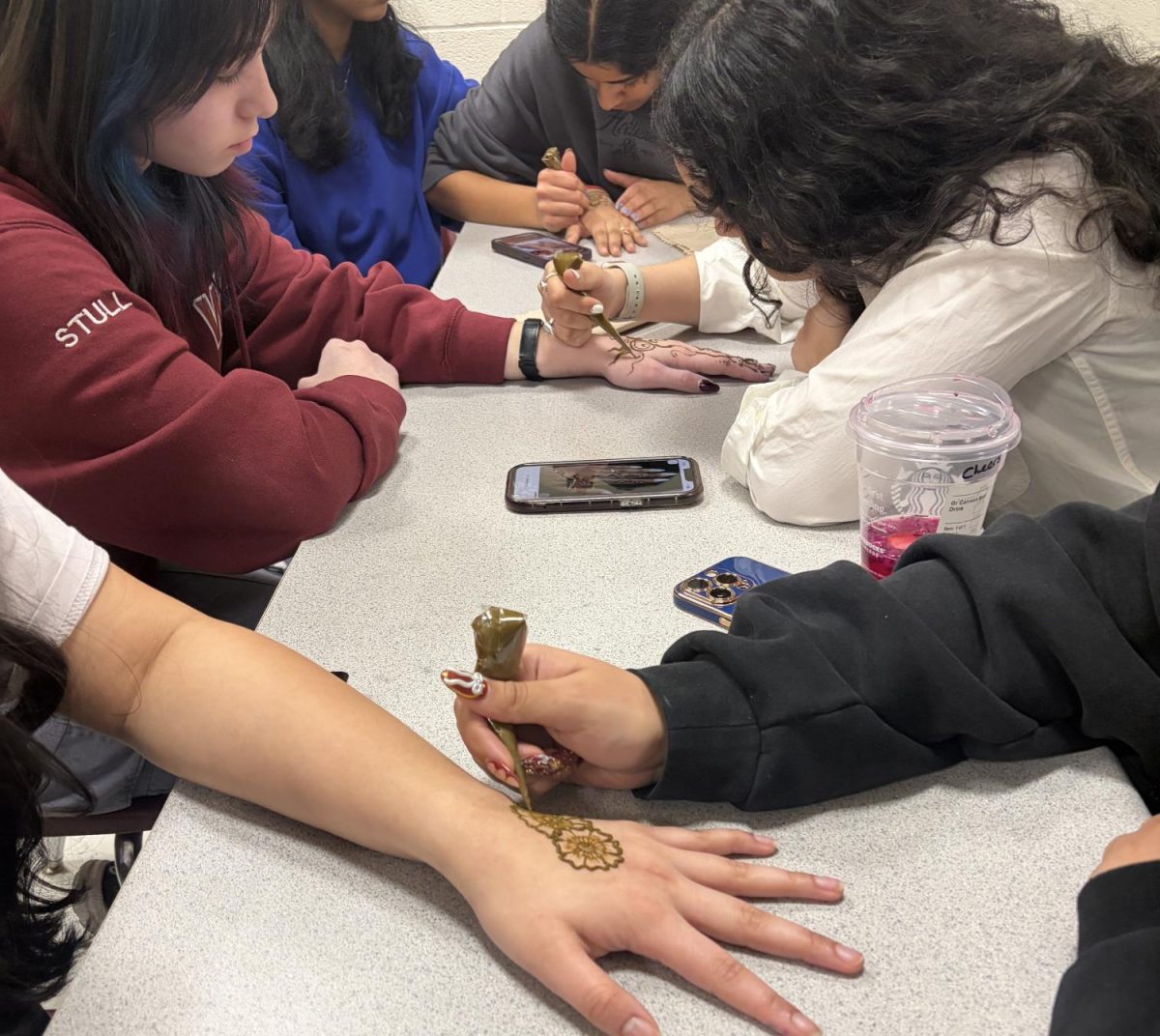
The meeting also included activities that were set up throughout the Lecture Hall including a couple of henna stations, a station for Tasbih bracelets, and one for Arabic writing. Students also had the opportunity to socialize with each other in between stations.
Attendees created lines in front of each henna artist and also tried Arabic calligraphy with the help of keys and templates. The tasbih beads—Muslim prayer beads—were a way to represent the dedication to prayer during Ramadan.
The clubs brought not only their own unique features—MSA with their valuable experience and SASA with their activities and platform—but also their respective club members. However, club members were not the only ones in attendance: several members of administration and teachers took part in the celebration as well. Kumar, MSA adviser and Spanish teacher Joseph Schmidt, dean Betsy Murphy, principal Dan Twomey, and English teacher Rebecca Shaw were a few of the staff members present.
Despite the varying roles between the two clubs, spreading more information about their cultures was an overlapping goal, ultimately leading to the collaboration between them.
“[MSA are] also a group of students who have really similar goals [as] we had discussed. I […] sent out an email, and they were really excited about [the joint celebration],” Kaza said.
According to Azmi, MSA cared a lot about having a way for students to share and learn in a respectful environment, which happened to also be an important value for SASA.
“I feel like the two clubs, despite targeting different groups of students, both have similar goals of providing a safe space,” Azmi said.
This special club meeting was also an outlet for MSA to reach out to different groups of people, those who are part of SASA but are not Muslim, and share more about their culture and their special month. SASA co-treasurer and junior Amruta Jidge also stated SASA’s main goal for this meeting was to create a place for everyone to connect despite culture or background.
“A lot of Muslims come from South Asia,” Mohd said. “[However] I’m from Malaysia, [which is in] Southeast Asia, […] and [I] would love to share my experience with everyone.”
Both SASA and MSA cabinets mentioned being hopeful for future collaborations due to the success of this meeting and how well their message and intentions were conveyed to the attendees.
“We would love to continue this tradition for [the] coming years […] especially because it brings two communities together,” Mohd said.