

“In a world where you can be anything, be kind.”
How many times have we heard this saying? How many times have we seen it as a sticker on a teacher’s laptop, a motivational saying in the counseling office, or even in a picture frame on a doctor’s wall? In elementary school, we treated kindness as a good quality, something to be looked up to and achieved ourselves. What changed from ten years ago to now, other than our handwriting and our height?
Back then, talking to someone who didn’t have anyone to talk to was kind. The buddy bench was watched with a sharp eye—the moment someone sat down, looking for a friend, it was a race to see who could get to them first. Today, talking to someone who doesn’t have anyone to talk to is judged. As if their “strangeness” was contagious, as if talking to someone “with no friends” meant that was how you would end up too.
Why is there such a separation between the Upper and Lower Cafe? Unspoken rules state only those who sat alone or were “odd” would sit in the Upper Cafe, while “normal” people sit in the Lower Cafe. Admittedly, in the past couple years these invisible lines have blurred slightly, but the difference is still clear. A timid suggestion to sit in the Upper Cafe is rejected often with resounding refusals, with groups of fifteen or more kids squeezed into each table in the Lower Cafe; all while the Upper Cafe remains with tables half empty.
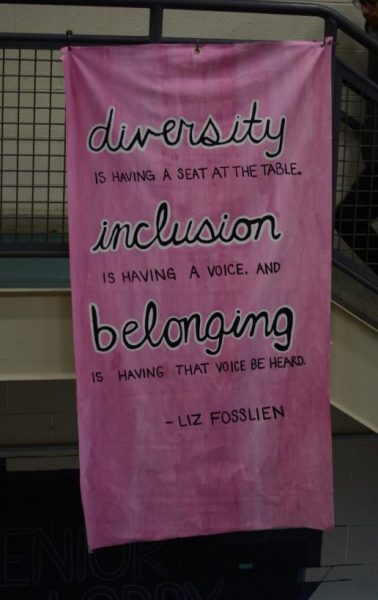
These judgements and predetermined biases are guilty contributors to an epidemic of normalizing disrespect. There is a noticeable difference in how people—often subconsciously—treat those who are perceived as “weird” as compared to anyone else. This cannot be our new normal. Human kindness and decency should be given to all, and everyone should be treated equitably. Be mindful of your own hidden biases and make a conscious effort to make sure everyone feels like they belong, not further ostracized.
Noticeably, this disrespect extends to teachers and subject matter, in clubs and sports. In history classes, students giggle, laugh, and exchange sidelong looks, making fun of a video of a black woman from the early 1900s singing about lynchings, solely because her voice and her cadence aren’t ones that they are used to. That is despicable, disgusting behavior. What is funny about suffering? What is funny about death? When we first learned about slavery in school years ago, the room was silent. I remember solemn faces and respectful words. What changed?
“It was extremely weird that people were laughing because it was such a serious topic. What’s there to laugh about?” Jane, a Westford Academy student in one of these history classes, said. “[The song is] literally about killing people. How hard is it to just be respectful?”
In middle school, club leaders most often treated everyone with fairness and respect: excited and reaching to help anyone at the slightest hint of confusion. Today, club presidents can let their positions go to their heads—making snide remarks about their cabinets and treating them as lesser than. “Kindness costs nothing.” Another quote we grew up hearing. Why do we act like it costs the world today?
In English classes, kids snicker when someone answers a question differently than conventional. In math classes, students laugh under their breath when someone gets the answer wrong. In science classes, classmates side-eye each other when a “stupid” question is asked. During practice, teammates trade harsh remarks when someone taps out early from a set. These actions and reactions are habitual, instinctual, and even expected nowadays. What is not expected is to recognize that this behavior is wrong and still continue to practice it. Just because this behavior is normalized today does not mean that it is okay.
At face value, everyone agrees that kindness is a good thing—but it is not often reflected in our actions. Just because no one’s been shoved into a locker or openly called a slur in the middle of the hallway does not mean this school is perfect. Every scenario mentioned so far is real and has happened at least once at Westford Academy, many of them more. These are not acts of kindness, and we have work to do.
“In my experience, ‘bullying’ or similar behavior has not once looked like how it’s often represented in pop culture. In fact, it’s almost never even conscious,” Dexter, a WA student who regularly deals with these behaviors, said. “For example, the teacher assigned groups and the people you were assigned to go ‘oh no’ and laugh—it’s more hurtful because insulting you has become so normalized that it’s been manifested into a fact.”
It is easy to get wrapped up in these actions and behaviors and excuse it by saying everyone does it. However, this rationale is a dangerous and historically deadly one. Every act of discriminatory violence began with a normalization of hateful remarks and disrespectful behavior: racial terror lynchings (United States, 1877-1950), the Partition Riots (India/Pakistan, 1947-1948), violence against Asian Americans in the aftermath of the COVID-19 pandemic (United States, 2020-2022), and many more throughout history. The U.S. lynchings were heinous acts that were never stopped because they became normalized. The Partition Riots were a result of months and months of built up resentment and harsh words about Hindus from Muslims and vice versa due to British intervention. The rise in Asian American violence occurred only after a rise in Asian American hate speech. Were these actions okay because “everyone did it”?
It’s time we realized that nothing has really changed from elementary school to now. As former president Abraham Lincoln once said, “Kindness is the only service that will stand the storm of life and not wash out.” Just because our homework is trigonometry problems and not coloring worksheets doesn’t mean that general decency is any less an expectation now than it was back then. Respect has never had an expiration date. The next time you go to scoff at something or someone because that’s just what everyone else does, remember to check yourself and reconsider if the person you were ten years ago would’ve done the same.
In a world where hate lies coiled around every corner and does not always rattle, don’t feed it. Make sure everyone knows where it is so that no one gets bitten. “No act of kindness, no matter how small, is ever wasted.” An older quote, but all the more relevant today. Call out hatred and disrespect when you see it. Comfort anyone you see that’s been hurt. Stand up for people who can’t or won’t stand up for themselves. Even the smallest kind word or act can turn the tide and take us one step toward making respect our new normal instead.