

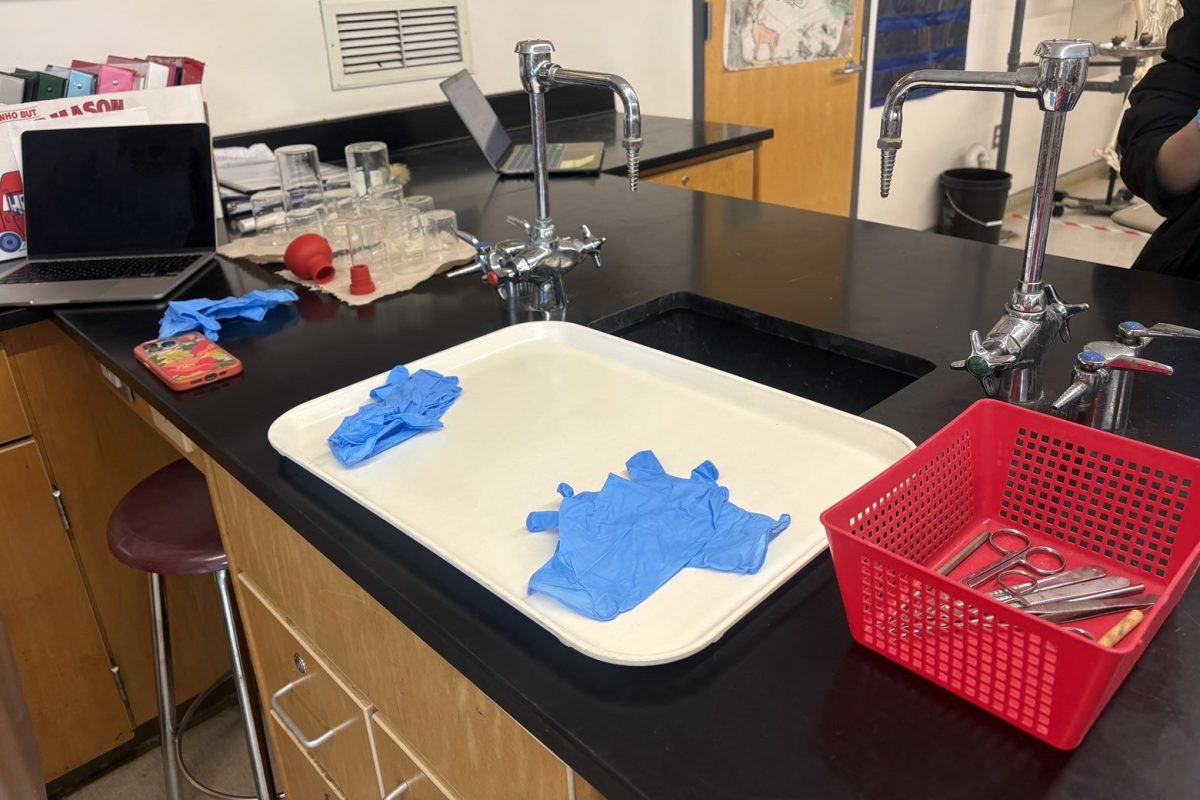
Due to a backordering issue, the Honors Human Anatomy and Physiology classes at Westford Academy have had to switch their annual animal dissection from the usual cat specimen to pig fetuses. Over the past few weeks, students taking the course have been dissecting their pig fetuses and working to learn about muscle and connective tissues within mammals through hands-on examination.
The Honors Human Anatomy and Physiology course is a full-year elective specifically designed for students who are looking to go into the medical field, with many students taking the course to prepare for either a pre-medical or nursing major. The course allows students to learn about the human body and its components before entering college.
In the past, the cat specimens used for the dissection portion of the course have been provided by Carolina Biological Supply. The company first informed Honors Human Anatomy and Physiology teacher Wayne Kotary that the cat specimens would be backordered to November. According to Kotary, this was not an issue as the course does not begin dissections until January. However, when Kotary learned that the cat specimens had actually been backordered until the summer, he was forced to choose a new specimen for the unit.
According to Kotary, the most important part of choosing a new specimen was ensuring that it was a mammal. This is because mammalian organisms carry the most similarities to the internal human structure. Kotary concluded that the fetal pigs were the best option, as they were large enough for their musculature and internal organs to be studiable.
“It wasn’t a cost thing, [even though] the cat [specimens] are more expensive that the fetal pigs, it was just about availability,” Kotary said.
While the pigs contain the most similarities to the cat specimen, they also carry some differences that change the dissection experience.
“The cat [specimens] are overall a little bit more preferable in terms of observation of anatomy,” Kotary said. “The cat [specimens] are a little larger, and since they’re adults, the features tend to be a little more observable for students.”
Despite this, for certain students in the Honors Human Anatomy and Physiology course, dissecting the pig fetuses was an easier idea to stomach than dissecting cat specimens.
“The cat [specimen] would’ve been a harder mental block for me to get over because I own cats,” senior Alveena Hammad said. “But I do think the cat [specimen] would’ve offered a much more defined and developed muscle structure compared to the softer and less mature muscles of the fetal pig.”
As for the dissection itself, Kotary began the unit with a lecture on the ethics of using fetal pigs. This statement emphasized that the fetuses were salvaged from pregnant sows that were to be processed for food, and how students must conduct themselves with maturity and treat these fetuses with the utmost respect.
In order to make the dissection guide more understandable, Kotary had to modify it slightly to apply to pig fetuses rather than the usual cat specimen, as well as rewrite the guide and diagrams he usually uses.
The students’ first step was to remove the skin of the pig fetus and identify the musculature. As students went through this process, they took photos of various muscles that Kotary instructed them to recognize, and made themselves a photographic identification guide so they can draw comparisons between the anatomy of the pig fetus and the human body.
“Although the muscles are smaller than those of humans, it has so far helped me understand the muscle structure a lot more,” senior Natalie Bearfield said. “The diagrams that we see in class or on our study guides appear very differently than real muscles do, so it’s interesting to see what they look like versus a drawing.”
According to Kotary, he has prepared the pig fetuses with preservatives and hopes they will stay in their condition over the week-long February vacation so students can open the abdominopelvic cavity and examine the digestive system, as well as some of the organs of the thoracic cavity. If the preservatives do not hold up, Kotary has extra pig fetuses that he will open up himself to ensure that all students have the chance to look at the different body systems.
In the future, Kotary plans to return to the cat specimen if possible, as they offer a slightly more developed and realistic view of musculature and organs. However, for now, the pig fetuses have proved to be a sufficient substitute according to many members of the class of 2026.

Rami Jaber • Mar 5, 2026 at 1:49 pm
Pretty cool