

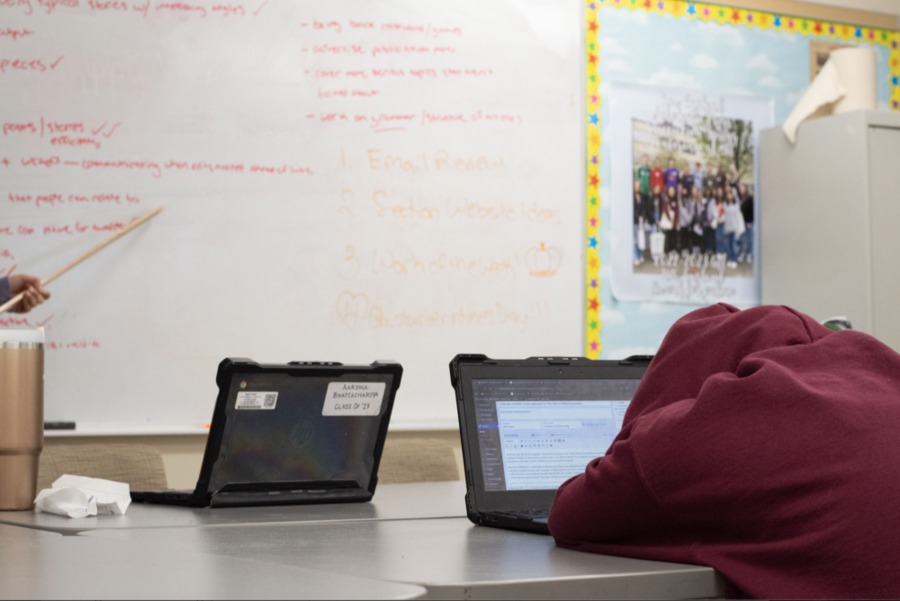
“But you’re already committed to a college, why do you care so much?”
Despite late nights spent poring over Psychology and AP European History notes and hours spent on math homework and equations, the question still lingers in the back of my head. The mentality of needing to succeed combined with the fear of having a college acceptance rescinded can be suffocating, and this is not just a personal experience.
Senioritis was a term that was coined in 1907 by The Chicago Alumni Magazine, but was not added to the Oxford English Dictionary until 2012. It is defined as “a supposed affliction of students in their final year of high school or college, characterized by a decline in motivation or performance.” Put more simply, as the end approaches, the incentive to succeed decreases. Senioritis is a commonly used phrase, however the sad truth is that many are unaware of the mental issues it can truly cause. More attention must be brought to this topic so parents and schools can take action instead of simply allowing their child to fail their last year of high school.
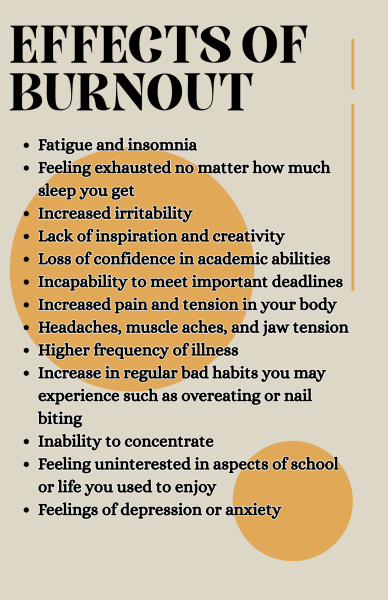
Many students put academic pressure on themselves to succeed, and spend their high school years working tirelessly toward their goals, but what often flies under the radar is what happens after the four years of constant schoolwork, tests, and homework — burnout. The effects of burnout should not go unnoticed, as it can cause both fatigue and insomnia, a lack of motivation to attend class or complete assignments, feelings of anxiety and depression, and so much more.
“In the fall, I was on time to school and stuff like that, but as second quarter hit, realizing I only have two more quarters of high school left, I’ve started to come in later and it’s more difficult to actually want to stay on top of my schoolwork,” senior Sophia Williams said.
Additionally, mid-senior year is the time when students receive a slew of college acceptances, deferrals, and rejections. No matter the decision that a student receives from a college, the period of time can evoke a variety of anxious thoughts and feelings. While Niche Research found that 23% of seniors fear choosing the wrong school to attend, Best Colleges states that 63% of students from low-income families deal with the stress of college affordability. Not to mention the anxiety of waiting to hear back from a top choice school, and the consequences a student’s mental health may face after reading a rejection letter. This only adds to the distractions that constantly swirl through senior year.
Although there are initiatives such as setting small achievable goals and using a planner to avoid disorganization that combat this lack of motivation and college-related anxiety, the idea of senioritis is one that has just been accepted by society, and it’s now normal for seniors to stop putting their full effort in. While burnout is widely regarded as normal and taking personal breaks from an intense academic labor is something people should engage in, the issue is not that black and white and students require more support to grapple with senioritis that one might think.
Students across all grade levels are no strangers to the split mindset of lacking the motivation to work while still feeling the need to perform well in classes. With burnout and other effects of senioritis, this split mindset is often emphasized. Although students often still want to perform well, the intense burnout can overpower that.
“The freedom of how it will feel after being accepted to college keeps me motivated, but it also demotivates me because it’s so close,” senior Ganajit Bhat said.
Not only can this be an issue for a student’s mental health, but it can also affect their next four years. When a student is accepted to a college, it is made clear that, although they have been accepted, if their academic performance experiences drastic changes, the college has the ability to rescind their acceptance. While uncommon, this still happens to about 20% of students annually, with two-thirds of those students experiencing a rescinded acceptance due to a drop in grades. The normalization of senioritis in society has prevented it from receiving necessary attention and effective solutions. Instead of simply accepting it as something that everyone will experience, schools and students should attempt to find ways to combat this in order to prevent students from sabotaging their progress and developing mental health issues.
The most prominent symptom of senioritis is not a dip in grades, but instead, the decreased drive to even go to school at all. Among high schools nationwide, seniors are most often the victim of chronic absenteeism, with 41% of seniors suffering from this during the 2023-2024 school year. Chronic absenteeism differs from normal absenteeism as it requires missing at least 10% of school, or more than 18 days.
For seniors, especially those in more challenging classes, missing a large number of school days can be severely detrimental. In challenging classes, every session is usually packed with information for a test that is most likely taking place in the near future. This can extend even further for students in AP courses, as students spend time in those classes working towards an AP test at the end of the year, and missing a few classes could mean missing an entire unit that will be on the eventual assessment.
Not only do absenteeism and tardiness affect grades, they can also have long-term social effects on a student. Not attending school can hinder a student’s ability to form connections with their teachers as well as their peers, which can have detrimental effects on a student’s social and communication skills. Additionally, it has been shown that students who are frequently tardy experience feelings of isolation, low self-esteem, and difficulty working in a structured environment. Welcoming the idea of senioritis with open arms can not only lead to unhealthy habits like these, but can have a disastrous snowball effect that lingers throughout a students’ college experience, and even their post-graduate career.
“Last [school] year I was tardy a lot, but this year it’s even more added onto that,” Bhat said. “I feel like since my grades aren’t as weighted as they were junior year, I have no need to come into class early.”
Among many schools, it is a common trend for students to face consequences such as detention or even suspension for tardiness and absences. As seniors are most frequently absent, this causes them to receive another layer of stress. While consequences are necessary, there are also preventative actions schools can take. Additionally, schools can identify students that are specifically frequent in tardiness and absenteeism, and provide mentoring and guidance as well as identify the root cause of the issue and attempt to help solve it rather than punishing students with detentions.
On the other hand, some students may fall on the other end of the spectrum; not allowing daydreams of college and graduation stifle their academic performance. A large part of this is mindset, and also the environment someone has put themselves in.
“I applied early decision to a college and got accepted early November, and I thought that would make completely unfocused on my grades, […] but it hasn’t been as bad as I thought it would be,” senior Joanna Finney said. “I think to some extent it’s being part of the WA community and being around others who are academically driven has forced me to get over my senioritis.”
While senioritis is not a problem everyone struggles with, it’s a widely known topic that should be addressed. Many know the concept, but how many have tried to look deeply into ways to overcome it? Mentally, there are actions students can take to tackle this aspect of senioritis as well. This can include making sure basic needs such as nutrition, sleep, and exercise are met before attempting to combat a difficult feat such a studying for a big test or writing an essay, and asking for help from a parent, teacher, or guidance counselor. However, what is most important is to find a healthy balance between enjoying senior year, and keeping up with schoolwork and attendance. Senior year is a large milestone, and it’s important to not get caught up in distractions and make sure to savor your last year of high school.
With this being said, it is not only the students’ responsibility to take care of this. Schools should also take note of the fact that by the fourth year of school, students are tired and often feel overworked and burnt out from juggling the college application process, schoolwork, and extracurriculars. Instead of focusing all assemblies around college and making large decisions, schools can also attempt to implement some guidance for creating healthy habits such as good time management skills and assuring students take time for self-care.
At such a stressful time, it’s crucial that senioritis is not treated as a joke. Rather, it should be more deeply researched. Senioritis stems from serious topics such as poor mental health and burnout, and if both school counselors and mental health professionals collaborate to do more research on the topic, more time can be taken to advise students on how to overcome and emerge from senior year with both success and a good mental state.
A lack of effort involving school is not a situation where the student nor the school can be held fully responsible, but rather all of society for passively accepting the idea of senioritis rather than taking strides to help seniors work through their struggles. The best method to find solutions is to tackle the unavoidable problems – the burnout and anxiety – and retort back to the root issue and see what can be done about it. With the heavy, academically-challenging environment at WA, the issue will only continue to grow if it is not addressed now.
