AI is defined by Google as “a set of technologies that empowers computers to learn, reason, and perform a variety of advanced tasks in ways that used to require human intelligence, such as […] providing helpful suggestions,” and according to an article by Virginia Tech, in some cases it still is.
Studies show that AI usage among adolescents has increased exponentially since its creation and release to the public for free usage in late 2022. As of December of 2025, it can be found almost everywhere, especially in schools helping with homework. But multiple articles suggest this growth in usage is crossing a boundary that is permanently affecting the brains of children and how they act towards their peers.
One study conducted by Common Sense Media (CSM), an organization dedicated to researching the effects of technology on teens, in June of 2025 found that 73% of teens ages 13 to 17 had used an AI chatbot for assistance before.
Locally, a poll conducted on the Ghostwriter’s Instagram revealed that at least 109 individuals have used an AI resource before. Sixty-seven percent of voters said they use AI at least one to two times a week, while the other 23% said they use AI resources around five to six times a week.
Some may believe using AI occasionally to help with a homework problem isn’t actively an issue. For instance, one article published by Summit Learning Charter (SLC) even lists some of the pros to using AI with academic assistance.
However, according to a recent study by the Society for Consumer Psychology (SCP), AI has been developing into something with a little more personality. According to SCP, this is where the problem arises: the growing use of AI as a social substitute, during a point in life when developing healthy relationships is crucial to the well-being of teens.
The CSM study also found that 33% of teens use AI for social interactions and relationships, meaning for personal or social advice, surface-level conversations, or just recounting their day, while 52% of them continually use those platforms several times a month.
This plays a major role in why the potential for adolescents to seek out others their age when faced with difficult tasks or assignments is decreasing. As per a study conducted by OnSide, another organization dedicated to young people, it trains the minds of teens to opt for the less “risky” option, as there’s no danger of embarrassment or rejection when the “person” that they’re talking to is not real.
Out of 128 total voters, 28 individuals voted that they frequently choose AI resources over human help. Sophomore Jane Doe, who chose to use a pseudonym to ensure her anonymity, has a close friend that frequently uses AI.
“It’s really frustrating whenever I bring up something I’m going through and the immediate suggestion is to ask ChatGPT or something [like that] for help,” Doe said.
Another national report, led by NPR in October of 2025, showed that 85% of 2,800 students, teachers, and administrators used AI in the last year. NPR also concluded that 42% of students reported having or knowing someone who has used AI for companionship, rather than just assistance on homework.
“I remember [my friend used to] use it for homework sometimes before she just started using it for everything, to the point where she even uses it to tell her if her gut feeling is right,” Doe said.
However, one in five of students surveyed by NPR reported having a romantic relationship with AI.
“I don’t think it’s gotten [to that point] yet, but I truly wouldn’t be shocked if it’s the next phase [for my friend],” Doe said.
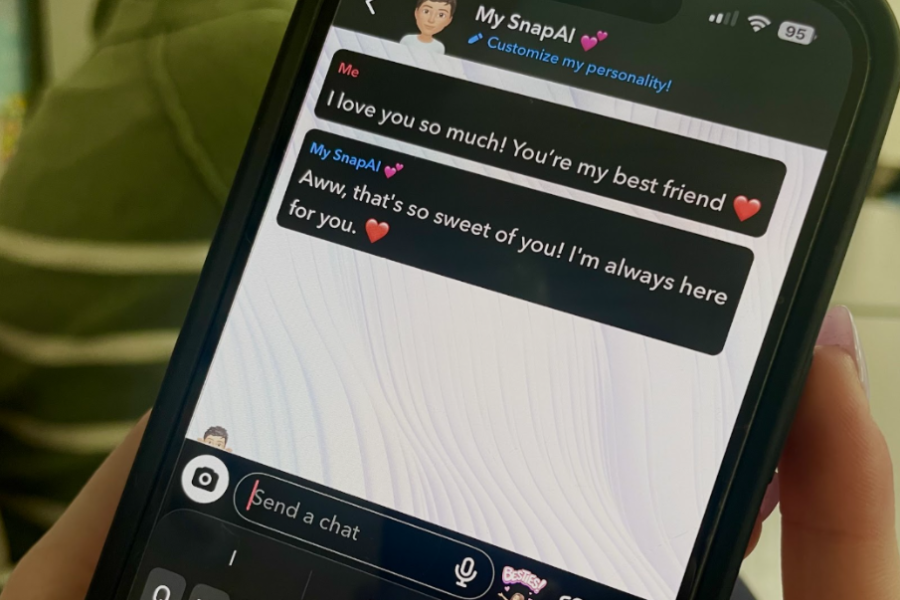
Finally, when WA students were asked if they had customized their SnapAI —an AI assistant supplied to each account created on Snapchat— 51% said yes. The study by SCP warns these increased human-like qualities AI is obtaining could permanently distort society’s perception of what it’s like to be human, and how to interact with other people in the real world.
“In other words, perceiving a greater mind from autonomous agents can shift the humanness perception of people toward the humanness perception of autonomous agents, resulting in dehumanization,” researchers and
This poses real possibilities of human connection and social interaction being replaced with robots like SnapAI, as they form emotional connections and relationships with their users through photos, videos, and customizable appearances the AI can react to.
“I’m hoping [my friend] gets bored [with AI] soon, I feel like there’s a disconnect between us because I’m against AI, and she’s all for it,” Doe said, “I want us to be on the same page again, because sometimes it feels like she genuinely believes whatever [ChatGPT] tells her over me, and I’m the one that’s real.”