

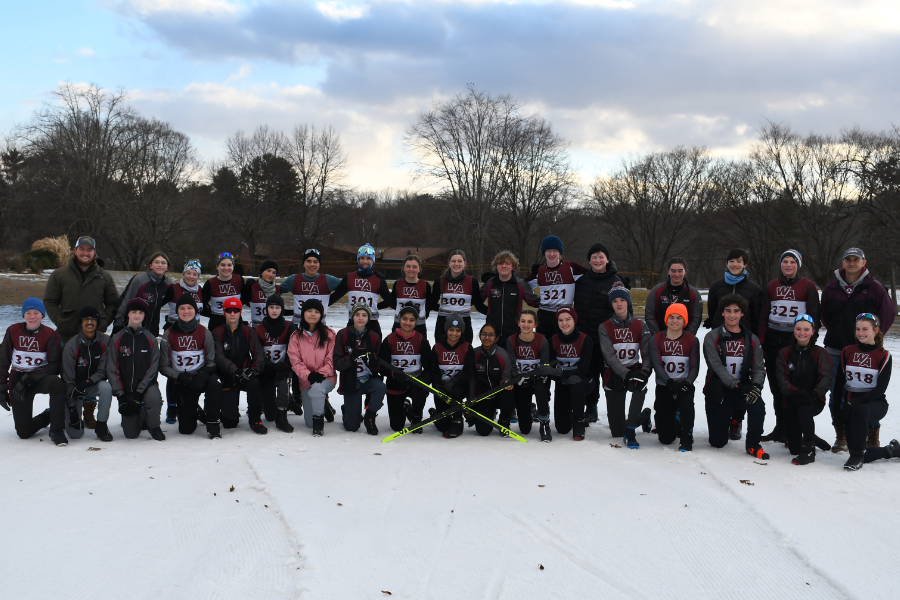
As skiers cross the finish line, icy air burns their lungs, and they can hear the sound of their coaches and teammates cheering them on. The snow under their boots crunches, and they can taste the cold air as they try to catch their breath and look up at the clock to see their time. This was the experience of many Nordic skiers last year as their team placed in the MIAA Nordic State Championship.
Last year, the girls’ team placed 12th at the state championship with 213 points, and the boys’ team placed 13th with 226 points. Although both teams had strong performances, their goal this season is to continue improving and climbing in the rankings.
According to senior captain Ella Raker, her goals are to focus on building a positive team atmosphere and forming a strong state race lineup.
“As a team, our goals include building a great state race team, placing higher than last year in our league, and having a great time,” Raker said.
Other goals include improving their strength and cardiovascular endurance to be better prepared for the course. The race itself stretches seven kilometers and deals with multiple terrains such as uphill, downhill, and flat land. Skiers rely on their poles and different techniques to finish the race. According to senior captain Nina Pierson, it’s important for skiers to have strong endurance.
“I want to give my team the opportunity to ski their best in the snow and to have cardiovascular strength and to build muscle,” Pierson said. “You’re not going to succeed without that endurance, and also having fun more than anything because if you’re not having fun it’s not worth doing.”
Along with the challenge that the distance of the race brings, snowfall has also been limited in recent seasons. Thus, because Nordic ski is weather dependent, the teams struggle the most when there is less snow. When there is less snow on race days, they ski on small patches of snow for multiple laps instead of long courses.
“If we don’t get a lot of snow, which happened my first two seasons, it’s not a great season. [There’s] not a lot of skiing, and our races consist of lots of laps on a small patch of snow instead of a long course with a few laps,” senior Nordic Ski captain Jakoby Dickson said. “Rain and other weather conditions also limit our time on skis because wet snow makes it hard to ski and could damage our equipment.”
When snow is limited, the team shifts to strength-building and dryland conditioning. The group usually starts with warm-ups and stretches, then the athletes run for different distances. When they get back from running, they do core exercises or bodyweight strength training.
Although weather plays an important role in the sport, the individual team members play an even more essential role. Nordic ski captains and advisors like to focus on the atmosphere of the team, and they aim to help all of the athletes succeed and have fun regardless of if they hope to compete in the state competition, or simply stay active.
In addition to their hopes of creating an inviting and encouraging atmosphere, they also are open to anyone joining, whether they’ve never skied before or if they ski all the time.
“We have student-athletes who’ll train and compete at the state level, and then we have people who are only with us three or four days a week,” Nordic Ski coach Andrew Norander said. “We are totally open to anybody, we welcome and encourage novices to join.”
Nordic also has other opportunities for team bonding with the novice skiers whether it be their weekly Saturday team ski, where they go to Vermont or New Hampshire, or their Joe Dodge trip where they travel to Vermont and stay a couple days to ski as a team. They also have weekly team bonding games every Friday.
According to Raker, the captains are also very excited for this season with the promise of snow and a great team.
“I think that we have a very strong team for this season and the predicted snowfall is high. I think this could be one of our best seasons yet,” Raker said.
