

Through its use in assignments and essays, the popularity of artificial intelligence (AI) has skyrocketed exponentially over the past few years. Behind the facade of efficiency, Generative AI (GenAI) blatantly tarnishes the creative world through its regurgitation of thousands upon thousands of paintings, sketches, and digital drawings without giving credit to the original creator.
GenAI can be used as an outlet for non-artists to easily step into the world of creativity, as it is a quick and cost-efficient way to make something visually appealing. It can take a daunting task of creating physical artwork and make it into something readily available for anyone. However, there are some major setbacks that come along with this accessibility.
AI continues to grow as, according to Artsmark, the art market value of AI was valued at over $3 billion in 2024 and is estimated to reach over $40 billion by 2033. According to MIT News, GenAI functions by using previously collected data and copying that data when individuals ask it about what can be improved. It is incapable of creating anything by itself, which has led to artists being uncredited as AI leeches off their images, raising serious ethical concerns. If industries continue in this direction, it will likely incentivise AI corporations to persist in the production and updating of their algorithm.
Along with its theft of art, AI is beginning to steal jobs from artists. Large companies, such as DoorDash and Kleenex, have used GenAI to develop their creative marketing, under the logic that AI is faster and cheaper. Companies sacrifice man-made art with raw emotions and culture for soulless, parroted material in order to meet a deadline. Instead of paying hard-working artists to make original and unique work, companies use AI in order to speed up the process, without thinking of the ethical impact their choices have. Companies like this make careless and creatively destructive choices that can be costly to artists’ livelihood. According to the Society of Authors, 26% of illustrators surveyed had already lost work due to GenAI.
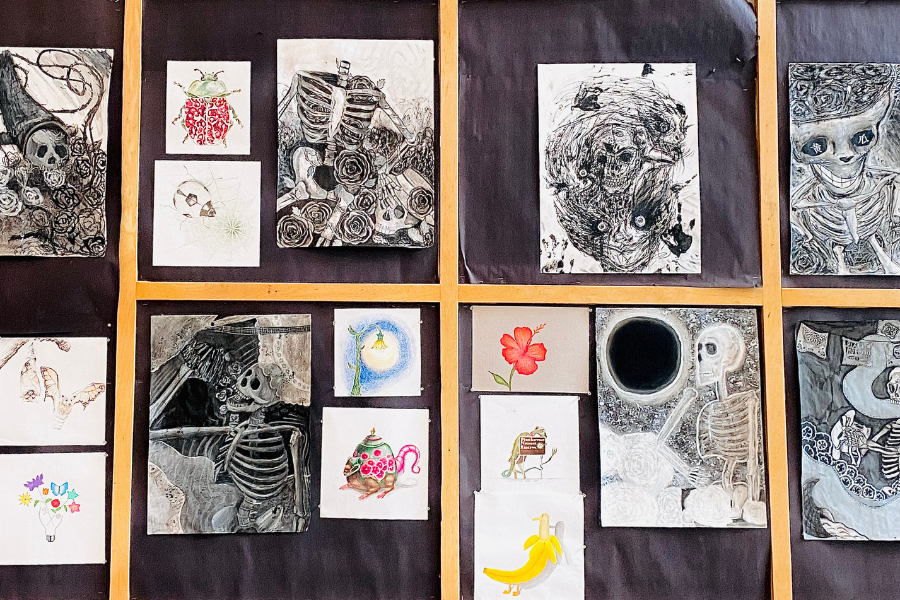
Locally, according to sophomore art student Clara Donaldson, WA students taking art classes have spoken about their dislike for generative AI’s lack of creativity. AI lacks the imperfections and liveliness that are shown within genuine handmade artwork.
“[AI] art has no soul, no emotion, no creativity, since the machine that created it has none of those things either,” Donaldson said. “Anyone can create art simply by picking up a pencil, and that creation, no matter how bad, would have one million times more heart and soul put into it.”
Below are two pieces of art, one made by an art student at WA and another created by AI. Both were created using the same prompt: “Create a drawing that has some abstractions while still retaining recognizable elements from the real world. On the final day of your project, you will be given all the materials [used previously] at once to have the opportunity to go back into the layered drawing with previously used materials and techniques, focusing on negative space and abstraction.”
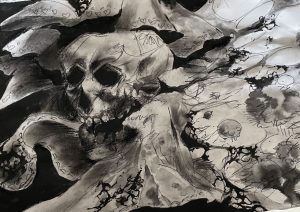
This piece of art was created by sophomore and National Art Honor Society member Emily Bourdon. The stark contrast between the charcoal and the light sections of the paper makes the piece of art more dynamic. The skull remains visible in the center of the paper, however, through a non-figurative background, Bourdon follows the prompt of focusing on negative space and abstraction. There is liveliness and meaning behind every stroke of her tools, showing the beauty that many WA art students strive for in their art classes, something that AI could never achieve.
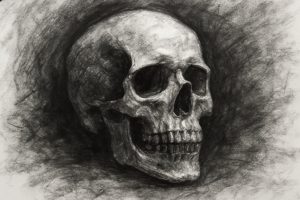
Meanwhile, this second picture was created by ChatGPT. The photo does display a contrast between the darks and lights, however, it does not have many aspects of abstractness. The skull is realistic, but the photo does not completely follow the prompt. The commonly seen AI flawlessness of the photo makes it seem so uncreative and uninspired. In comparison to the first piece of art, the second image lacks imagination and uniqueness.
“AI isn’t actually art, it is taking bits and pieces of others’ work and calling it your own,” freshman art student Chloe Gallagher said. “It doesn’t have meaning or emotion behind it.”
This comparison shows the stark contrast between AI and human-created art. Through the increase of AI in media and art, many people, including WA students, are feeling the impact on their creativity and expression. AI has caused people to lose aspects of their self-expression and self-exploration that are conveyed through the creation of art.
I have also noticed a major change in art over past few years. AI has stripped away the authentic emotional depth that is shown in human made artwork and has left behind a hollow shell of images. Overall, it has been disheartening to see so many people steer away from picking up a pencil to instead generate something they deem looks better. Part of the process of creating art is growing, improving, and learning from the mistakes you have made in the past.
Next time you have the impulse to create something, I urge you to pick stationary and create it yourself instead of leaning on AI. It might not be perfect the first time, but that is a part of the undertaking of making art. Design something that reflects who you are, mistakes and all.
