

In the quiet but ever restless backstage of WA’s auditorium, the woodworking shop is ridden with spare two-by-fours and recycled cuts of wood. The final set piece off of Facebook Marketplace has been brought onto the set, and finally the last screw is drilled and the last pillar is painted. The stage is a kingdom that could only be conceived of a fairytale story and the actors are ready to captivate.
Westford Academy Theater Arts (WATA) once again takes to the stage to immerse audiences in a new theatrical production. This year’s undertaking is the classic German folktale Cinderella, adapted into musical form by Richard Rogers and Oscar Hammerstein. The cast and crew, led by artistic director Michael Towers and director Maggie Sulka, will be making its debut at the WA Performing Arts Center on Nov. 14.
Cinderella is the hallmark tale of a girl who lives in servitude to her stepmother, and decides to sneak out to Prince Christopher’s ball against her stepmother’s wishes, all with a little help from her fairy godmother. There, she dances with him, sparking their love story and changing Cinderella’s destiny from a life in rags to a happily-ever-after ending.
Those acting include, but are not limited to, junior Maya Galli as Cinderella, seniors Viktoria Kariuki and Ella Trethaway as Fairy Godmother, senior Lacey Fraser as Step Mother, senior Sky Lokere as Grace, senior Trinity Murphy as Joy, sophomore Austin Kane as Christopher, junior Phoenix Daily as Lionel, senior Erin Goucher as Queen Constantina, and sophomore Benjamin Fernandez as King Maximillian.
There is much time that is required to rehearse before such a spectacle can be put on, the events of which can evince an intriguing narrative. One element integral to the assembly of any theatrical production is rehearsals of varying intention such as blocking, music, tech and building.
According to junior technician and ensemble Tyler Pelta and junior technician Zolivia Nastasia, while days might have a target focus, multiple types of rehearsals often occur at the same time in order to achieve maximum efficiency. While principal actors—students who portray specific characters or named roles—might be rehearsing songs and lines, it is not uncommon for set designers and technicians to be working on the play’s set elements or troubleshooting issues with the set and props at the same time.
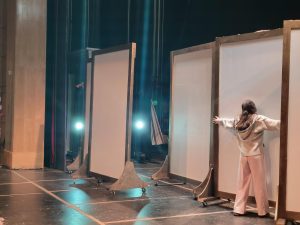
“My favorite part about this show is the intricate design of the set. The design of the palace, [for example], is very specific, grand, and royal,” Pelta said. “I like making a more complicated set but that also leads to more challenges. [For example], we have a lot of moving pieces and I think that’s going to be really fun to work out [even though] it’s going to create problems.”
Another department of the production which has proved especially challenging for the design branch of WATA has been the costumes. According to Sulka, Cinderella became a very costume-focused production, as the effective employment of costumes is fundamental to the immersion of the audience. Ultimately, implementing immersive costume design outweighed the potential that such costumes might be obstructive for actors to wear or otherwise unusual for teenagers of the modern day.
“How people move in heels determines how they walk through a space and wearing a big ball gown, you’re going to move differently than you would if you were in jeans or sweatpants and sneakers. That’s going to be a really big contributing factor to character, because everything has to serve the story,” Sulka said. “We spent a lot of time looking for an awe-inducing dress for Cinderella, because that it is something that people have an expectation and an anticipation for, so we wanted to make sure that we really wow them.”
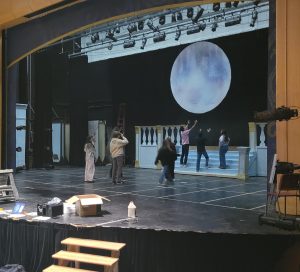
On the less technical side of things, principal and other actors take a different approach to their rehearsal time. Oftentimes they practice their actual positions and actions on the stage in blocking rehearsals. They might also practice their songs or lines in music rehearsals or as a side task to accompany activities in which they are not involved. Another common practice is to work to further develop and personally embellish upon their characters.
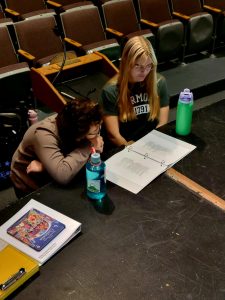
“At first I was trying to be more timid because I thought that was what was necessary. Then my lovely director, Maggie, gave me a note [telling me to] bring out more of [myself] in the character, which is something you don’t hear that often,” Galli said. “It’s been really interesting, figuring out what things I have in common, how I can access myself, but also keep the character intact.”
According to Sulka, due to the variety of retellings of Cinderella, a certain amount of freedom of interpretation comes with putting on its production. Despite the the most widely known version of Cinderella, the Disney cartoon, portraying the soon-to-be princess as a more timid and less outspoken individual, Sulka encouraged Galli to act as a more self-determined character. A similar approach has be taken with other characters such as Prince Christopher.
“In the beginning of the play, [Christopher] is trying to find that one thing that will make him feel [complete]. so especially in his first interaction with Cinderella, he finds her to be someone very easy to talk to and that sparks his interest,” Kane said. “[However], in my version, his parents are very much trying to pressure him to find a wife but he’s wanting to be more independent from his parents, which I feel is different from the cartoon.”
Each actor individually impacts the production on the level of the character in which they portray. But the big picture, determined by the directors of the musical, impacts all of the production team, on and off stage.
“In the version that this [musical] is based off of, Cinderella has a bit more agency, and also is pushed a bit more by her godmother, and things aren’t happy go-lucky. It’s her responsibility, that if she wants her life to change, that she needs to do it,” Sulka said. “She can wish all she wants, and at the end of the day, if she wants to have a wish, instead of sitting around and waiting for it to come true, she can make it happen.”
